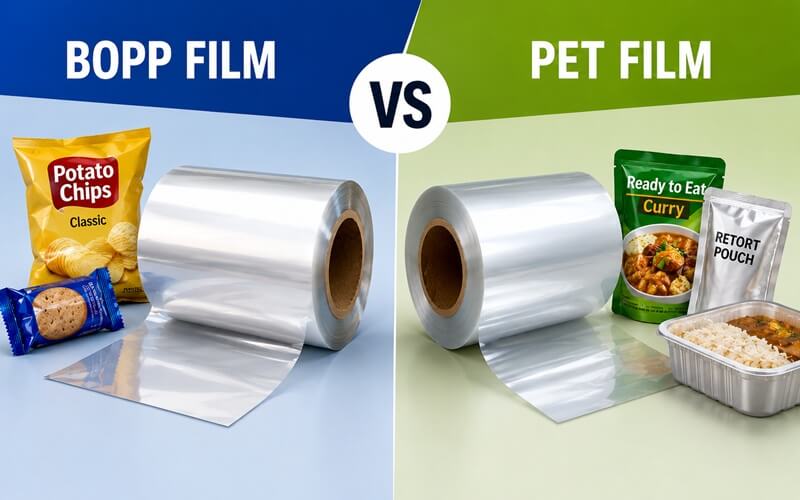
Flexible packaging is redefining modern manufacturing significantly in modern times. Every packaging decision influences product quality and market performance. Manufacturers constantly pursue materials delivering dependable, consistent protection. They also seek greater operational efficiency and lasting value.
Material selection affects storage, transportation, and customer satisfaction alike. Small packaging choices often create surprisingly significant commercial outcomes. BOPP vs PET Film remains an industry-wide discussion. Both materials offer distinctive strengths under varying operating conditions. However, neither material meets every packaging requirement equally well.
BOPP provides impressive moisture resistance and exceptional print clarity. Meanwhile, PET delivers outstanding strength and superior thermal stability. These contrasting characteristics often complicate purchasing decisions considerably.
Manufacturers carefully evaluate applications before finalizing material selection. They also balance performance expectations against production economics. As a result, informed comparisons become commercially indispensable today. Industry trends consistently reinforce this growing market preference.
-
According to Grand View Research, the global BOPP films market was valued at approximately USD 31 billion in 2025.
-
The market is projected to reach nearly USD 50 billion by 2033, reflecting sustained industry growth.
-
Rising demand from the food, FMCG, pharmaceutical, and e-commerce sectors continues to drive the global flexible packaging market.
Understanding BOPP and PET Films
Each packing film has a distinct material personality. Understanding those distinctions is necessary to avoid costly production compromises. BOPP is controlled multi-directionally stretched. This treatment improves clarity, rigidity, and moisture resistance very effectively. Manufacturers like its cost-effective production and processing. Thus, BOPP rules snacks, labels, and overwraps.
PET, or Polyethylene Terephthalate, has excellent mechanical endurance. It can tolerate high temperatures without breaking down. PET serves medications and retort packs. Both materials confidently meet industrial needs. JPFL Films offers BOPP, PET, metallized, coated, and CPP films to enable different industries/businesses to find packaging solutions that meet their needs rather than forcing one material on them.
BOPP Film vs Polyester Film: Key Differences Explained
-
Raw Material: Polypropylene vs Polyester
-
Moisture Barrier: BOPP performs exceptionally well
-
Oxygen Barrier: PET offers better protection
-
Heat Resistance: PET withstands higher temperatures
-
Transparency: Both deliver excellent visual clarity
-
Mechanical Strength: PET provides greater durability
-
Chemical Resistance: PET resists harsh chemicals better
-
Cost: BOPP remains more economical overall
-
Recyclability: Both support recyclable packaging solutions
-
Printing Performance: Both ensure outstanding print quality
-
Shelf-Life Needs: Choose according to application
-
Processing Conditions: Temperature influences material selection
-
Performance Priorities: Match properties with requirements
-
Selection: No universally superior packaging film.
Where BOPP Films Perform Best
BOPP films embrace diverse industrial packaging applications effortlessly. Snack packs preserve irresistible freshness through dependable moisture resistance. Bakery products and biscuits retain delightful texture considerably longer. Pulses and frozen foods remain protected against environmental exposure.
Moreover, vibrant labels display exceptional print quality with striking clarity. Adhesive tapes deliver steadfast performance through durable film construction. Textile packaging preserves fabrics against dust and handling damage. Lamination enhances visual elegance with polished surface brilliance.
FMCG and retail packaging demand lightweight, economical material consistently. Consequently, businesses favour BOPP films for dependable efficiency. Hence, superior clarity, impressive durability, and cost-conscious performance create enduring commercial value.
Where PET Films Offer Better Performance
Applications at a Glance
-
Retort packaging
-
Pharmaceutical packaging
-
Industrial laminates
-
Electronics
-
Electrical insulation
-
High-temperature packaging
-
Premium food packaging.
PET is preferred for:
-
Better thermal stability
-
Higher tensile strength
-
Better dimensional stability
-
Excellent puncture resistance.
Which Film Is Better for Food Packaging?
Selecting suitable food packaging films demands thoughtful technical evaluation. Every packaged product presents distinct preservation challenges. Not only shelf life and freshness but also appearance seriously influence buyers’ decisions.
BOPP excels where moisture protection plays a critical role. Moreover, it supports rapid packaging operations with ease. Manufacturers often choose BOPP for snacks and confectionery. Bakery products also benefit from remarkable clarity consistently. PET, however, embraces demanding thermal environments effortlessly. It handles sterilization and retort processing without compromise.
In particular, premium barrier structures favour PET confidently. Nevertheless, neither material solves every packaging challenge alone. Modern laminates combine BOPP and PET intelligently. As a result, manufacturers balance protection, performance, sustainability, and commercial efficiency beautifully.
Wrapping Up
Why Manufacturers Prefer Integrated Film Suppliers like JPFL Films
Choosing packaging films calls for experience beyond just comparing technical specifications. Every application follows distinct operational and commercial priorities. Rather than simply supplying packaging films, experienced manufacturing partners help businesses make informed material choices that strengthen long-term operational efficiency.
JPFL Films, India's largest manufacturer of BOPP and BOPET films, combines integrated manufacturing capabilities with an extensive portfolio comprising specialty coated, metallized, CPP, and thermal lamination films to address a wide spectrum of packaging requirements. Moreover, global quality standards enhance every production stage for superior quality.
Strong research capabilities inspire customized packaging solutions at JPFL. Technical specialists recommend films matching practical application requirements precisely. They never advocate one solution for every challenge.
Ultimately, no universal packaging champion truly exists. Product characteristics always shape the ideal material choice. Shelf-life expectations, machinery, storage, budgets, and sustainability influence decisions collectively. Hence, partnering with JPFL Films helps businesses unlock dependable packaging performance and enduring commercial value.
FAQs
What is the main difference between BOPP and PET films?
BOPP offers excellent moisture resistance, clarity, and cost efficiency, while PET provides superior heat resistance, mechanical strength, and dimensional stability for demanding packaging applications.
Which film is better for food packaging: BOPP or PET?
Neither is universally better. BOPP suits snacks, bakery, and confectionery, whereas PET is ideal for retort, sterilized, and high-temperature food packaging applications.
Why do manufacturers combine BOPP and PET in packaging structures?
Combining BOPP and PET allows manufacturers to balance moisture protection, heat resistance, strength, printability, shelf life, and overall packaging costs within one laminate.
What industries commonly use BOPP and PET films?
These films are widely used across food, FMCG, pharmaceuticals, electronics, labels, industrial laminates, textiles, and flexible packaging due to their versatile performance characteristics.
Why should businesses choose JPFL Films for packaging solutions?
JPFL Films offers an extensive portfolio of BOPP, PET, metallized, coated, and CPP films, backed by integrated manufacturing, technical expertise, and application-focused packaging solutions.