Indian brands now chase cleaner packaging without hesitation. Shoppers notice overflowing bins beside crowded marketplaces every day. Consequently, manufacturers explore smarter materials with genuine urgency. Food companies demand fresher storage with reduced wastage. Meanwhile, pharma brands prefer safer moisture-resistant packaging solutions.
Many manufacturers now replace bulky containers with alternatives. For instance, flexible packaging film saves transport fuel effortlessly. Moreover, lightweight packs reduce warehouse pressure during the summer. Consumers now touch smoother recyclable wraps inside supermarkets. Nevertheless, companies still battle inconsistent recycling systems nationwide. However, innovation steadily transforms packaging floors across Indian industries.
Understanding Sustainable Packaging in 12 Quick Points?
-
Reduces unnecessary packaging waste
-
Supports cleaner manufacturing practices
-
Encourages the adoption of recyclable materials
-
Minimizes transportation fuel consumption
-
Improves long-term resource efficiency
-
Strengthens sustainable supply chain operations
-
Promotes circular packaging economy
-
Lowers industrial carbon emissions
-
Enhances product protection standards
-
Meets evolving expectations
-
Aligns with ESG goals
-
Encourages responsible packaging innovation.
Major Trends in Sustainable Packaging in India
Rise of Flexible Packaging
Most Indian companies demand lightweight, flexible packaging. These materials greatly cut storage and shipping costs. Flexible packaging film helps not only the food and pharmaceutical industries but also the retail sector. Thus, producers reduce gasoline usage and speed logistics. Packaging that is sturdy, portable, and handy is also popular.
Recyclable Mono-Material Packaging
-
Supports easier material recycling
-
Encourages repeated material reuse
-
Reduces landfill packaging waste
-
Simplifies waste segregation processes
-
Improves recycling system efficiency
-
Minimizes complex packaging layers
-
Promotes circular packaging practices
-
Lowers raw material dependence
-
Enhances sustainable packaging goals
-
Strengthens responsible waste management.
Smart & High-Barrier Packaging
Now you can take fresh snacks farther without losing their quality. Also, pharmaceutical businesses are asking for stronger materials that can't be contaminated easily. High-barrier packaging does a good job of keeping out:
-
Moisture
-
Oxygen, and
-
Outside pollution.
On the other hand, people believe sealed goods that look better are safer to store. Ultimately, smart packaging makes the food and healthcare industries more reliable.
Sustainable Printing & Reduced Material Consumption
-
Digital printing reduces excessive packaging material wastage
-
Thin-film technologies support lightweight, sustainable packaging structures
-
Manufacturers improve printing precision with reduced resource consumption
-
Advanced printing methods lower industrial production waste significantly
-
Sustainable packaging designs not only enhance efficiency but also durability.
Popular Sustainable Packaging Materials in India
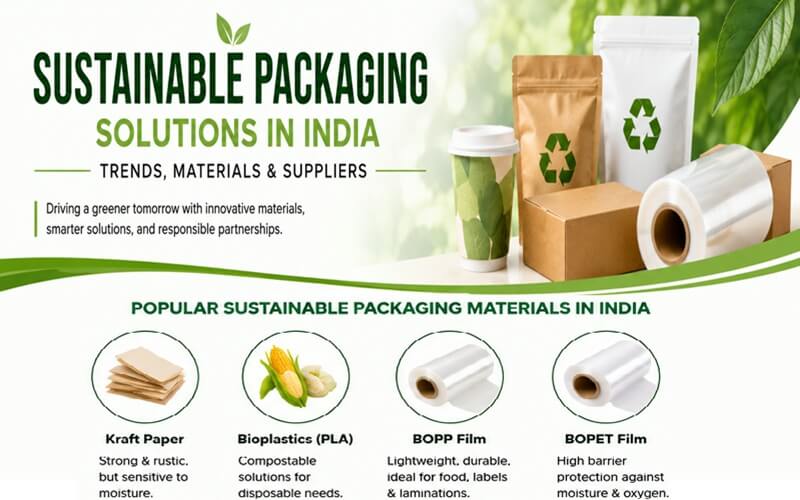
Indian industries now experiment with diverse sustainable packaging materials. Kraft paper packaging offers strength with a familiar rustic texture. However, paper materials often weaken during prolonged moisture exposure periods. Meanwhile, bioplastics attract brands seeking compostable packaging alternatives nationwide. PLA materials now support disposable food packaging applications effectively.
Nevertheless, limited recycling infrastructure still restricts wider commercial adoption significantly. Advanced polymer films now transform modern packaging across multiple industries. Consequently, manufacturers prefer durable films with improved moisture resistance properties.
BOPP Film now dominates modern food packaging applications nationwide. Brands use it for snack wrappers and retail packaging. Manufacturers also prefer it for labels and decorative laminations. Furthermore, BOPP Film offers lightweight yet durable packaging performance. It reduces transportation load and overall packaging material consumption. Consequently, companies lower logistics expenses without compromising product safety. Meanwhile, BOPET films support demanding industrial packaging environments effectively. These films provide exceptional barrier resistance against moisture and oxygen.
Industries Driving Sustainable Packaging Demand
Food companies now want their packaging to be cleaner and look better on the shelf. At the same time, e-commerce companies cut down on unnecessary wrapping during national deliveries. More and more, the pharmaceutical industry needs packing materials that are clean and won't get contaminated. Also, cosmetics companies now stress sustainability in all of their high-end product lines.
Durable packaging is also used in agriculture to make shipping safer. Also, companies now find a balance between longevity and using less material. Lightweight packaging makes logistics more efficient without lowering the total safety of the product. Ultimately, sustainable packaging now affects what people buy in many different businesses.
Also read: Challenges and Solutions associated with Sustainable Packaging
Challenges in Sustainable Packaging Adoption
-
Limited recycling infrastructure availability
-
High sustainable material costs
-
Inconsistent waste segregation practices
-
Low consumer sustainability awareness
-
Complex multi-layer recycling processes
-
Limited rural recycling facilities
-
Expensive biodegradable packaging alternatives
-
Inefficient collection and sorting
-
Poor recycling technology adoption
-
Supply chain sustainability challenges
-
Limited industrial recycling partnerships
-
Weak packaging disposal systems.
Wrapping Up
Reliable packaging suppliers now shape sustainable industrial growth across India. Furthermore, manufacturers increasingly prioritize innovation alongside consistent packaging performance standards. Advanced research now drives smarter and recyclable packaging material development.
Consequently, businesses prefer suppliers offering scalable and future-ready packaging solutions. Jindal Poly Films continues to strengthen India’s advanced packaging manufacturing landscape. The company produces high-quality BOPP and BOPET packaging films nationwide. Moreover, Jindal Poly Films offers coated and metallized specialty films. Manufacturers also prefer its CPP and flexible packaging film solutions.
Meanwhile, ongoing investments support advanced packaging expansion across growing industries. These innovations improve durability, printability, and moisture protection during transportation. In addition, recyclable film technologies now encourage cleaner packaging operations. Ultimately, reliable packaging partnerships strengthen long-term sustainability and industrial efficiency.