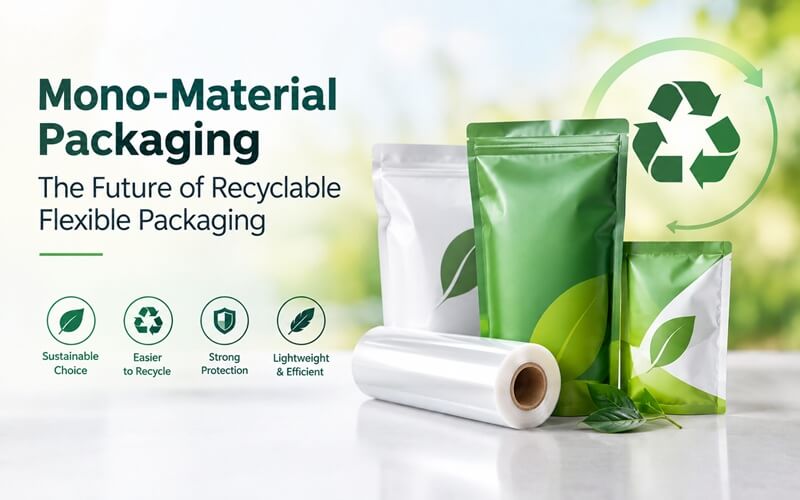
Flexible packaging has a tough task. It must be light and easy to handle, but at the same time it must be sturdy enough to protect what’s inside. This is more difficult if a pack contains a number of different materials, as they are not always easy to separate in the recycling process. This is part of the reason why mono-material packaging is getting so much attention. Making the structure simpler can make it more practical to recycle, without necessarily losing the performance required of packaging.
What Is Mono-Material Packaging?
Mono-material packaging is simply packaging composed primarily of one type of polymer as opposed to a combination of other families of materials. PE- and PP-based constructions are typical examples for flexible packaging. The premise is very simple: if the diverse components of a pack are made from the same material family, then the structure can be easier to manage in a suitable recycling system.
But that doesn't mean every mono-material pack is automatically recyclable. Its real recyclability may still be dependent on coatings, inks, adhesives, additives, thickness, and availability of adequate recycling facilities.
Traditional Multilayer vs Mono-Material Structures
|
Aspect |
Conventional Multilayer Structure |
Mono-Material Structure |
|
Material composition |
May combine different polymer/material families |
Primarily one material family |
|
Performance |
Can offer highly tailored barrier/protection |
Performance must be achieved within the chosen material family |
|
Recycling compatibility |
May be more challenging where materials need separation |
Can potentially be more compatible with relevant recycling streams |
|
Design flexibility |
High |
Increasing with advances in film technology |
|
Key challenge |
Material separation/recycling |
Maintaining barrier and performance requirements |
What Is Mono-Material Packaging Designed to Achieve?
The principle of mono-material packaging is quite simple: make the pack easier, but not by taking away the traits it needs to accomplish its function. By maintaining the structure in one material family, there can be a reduction in compatibility difficulties between layers, and the package can also be easier to recycle via an appropriate recycling system.
But minimalism by itself can’t make packaging sustainable. Designers still need to think about how well it protects the goods, maintains shelf life, makes economical use of material, and performs in manufacturing. That's where planning for recyclability becomes vital – thinking about the package from manufacture to end of life.
What Is Mono Packaging?
Mono packaging is commonly understood to be packaging made predominantly from one material family. While the word might imply the whole pack is made of one substance, that's not always the case. Technically, the term mono-material packaging is more precise: it refers to the entire structure, which may include numerous layers or components, provided they are all within the same family of suitable materials.
What Are the 4 Types of Packaging Materials?
4 Broad Packaging Material Categories
|
Material |
Common Applications |
Key Strength |
|
Paper/Paperboard |
Cartons, boxes, paper-based packs |
Lightweight and printable |
|
Glass |
Bottles, jars |
Excellent barrier and inertness |
|
Metal |
Cans, closures, foils |
Strength and barrier protection |
|
Plastics |
Pouches, films, containers |
Versatility and lightweighting |
What Is a Single Material or Mono-Material?
Using a single material for a pack sounds uncomplicated at first appearance, yet flexible packaging usually needs multiple layers to perform diverse functions. These layers can be in a mono-material structure, provided they belong to a compatible family of materials. That’s a difference from traditional multilayer packs that can mix up different polymers. PP-based BOPP and CPP layers each can contribute qualities such as strength, printability or sealability while maintaining the overall structure largely within the same material family.
12 Reasons Why Mono-Material Packaging Matters for Flexible Packaging
-
Improves Recycling Compatibility
-
Supports Lightweight Packaging
-
Protects Products Effectively
-
Provides Moisture Protection
-
Helps Manage Oxygen Exposure
-
Ensures Reliable Package Sealing
-
Offers Better Mechanical Strength
-
Supports High-Quality Printing
-
Reduces Overall Package Weight
-
Optimises Packaging Volume
-
Encourages Smarter Material Design
-
Balances Performance and Recyclability
What Are the Challenges of Mono-Material Packaging?
|
Challenge |
Why It Matters |
Industry Response |
|
Barrier performance |
Protects sensitive products |
Advanced film/coating technologies |
|
Sealability |
Needed for package integrity |
Engineered sealing layers |
|
Strength |
Prevents tearing/puncturing |
Film orientation and structural design |
|
Recyclability |
Determines end-of-life potential |
Material simplification and design-for-recycling |
|
Infrastructure |
Recycling varies by region |
Align packaging with available systems |
Concluding Remarks
Flexible packaging is gradually being developed with the whole life cycle in mind, rather than just its shelf performance. Manufacturers are encouraged to produce better-performing mono-polymer structures, improve film technology and use materials more intelligently.
At the same time, increased coordination between film producers, converters, brands, recyclers and policymakers will drive progress. The idea is not to replace every multi-layer pack, but to create structures that protect the goods enough and make their eventual recycling more practicable.
That’s where corporations with large film-making capacities can play a role. JPFL Films makes BOPP, BOPET/PET, CPP and specialized films for flexible packaging, labels, laminates, lidding and industrial applications.
The company’s coated and metallized films bring additional capabilities, while its focus on material optimization, energy saving and recycling mirrors the industry’s broader move towards more resource-conscious packaging. Rather than providing a universal answer, such skills might help build package architectures that weigh performance against end-of-life concerns.