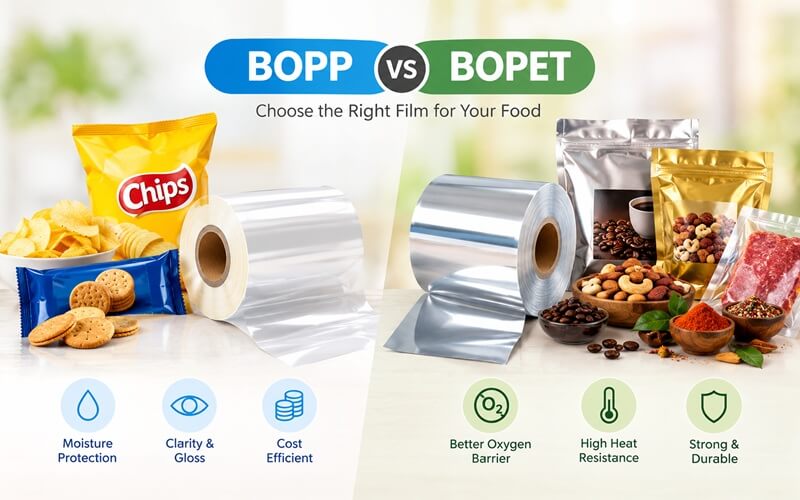
A protective plastic film is required for packaging of a wide variety of chips and biscuits. It is the nature and quality of that film that ultimately ensures prolonged freshness of the products and keeps them ready for consumption. The aspect of BOPP vs BOPET is one of the most significant aspects that can be discussed in this regard. Both these films are produced in the same manner but there are a number of differentiating factors. This blog explains those differences so that a sensible choice can be made for any product in the field of flexible packaging
What These Films Actually Are
BOPP stands for biaxially oriented polypropylene and BOPET stands for biaxially oriented polyethylene terephthalate and it is often called polyester film. The manufacturing process is almost same for both these sheets. The sheet is then stretched along the machine direction and across it. 0.91 gms per cubic centimetre is the density of polypropylene and 1.39 it is for polyester. A kilogram of BOPP therefore covers a larger area. This fact is often used by buyers to lower the cost of every pack.
Barrier Performance Compared
Barrier strength is where the two films separate most clearly. A good barrier against water vapour is offered by BOPP. In order to keep the food product crispy and crunchy, only a few grams of moisture can penetrate a 20 micron grade. Oxygen is a different story. Plain BOPP allows a lot of oxygen to pass and fats inside the food can turn rancid over time. Oxygen is blocked far better by BOPET and its transmission rate is often a tenth or less of that of BOPP at common thicknesses. Moisture protection of polyester is weaker though. Both films are therefore often coated or metallised when a stronger shield is needed. Aluminium metallisation improves the barrier of either film by a very large margin and light is also kept away from the food.
Heat Resistance and Sealing
Polyester is known for thermal stability. It melts at about 250 degrees Celsius while BOPP softens near 160. This makes BOPET a natural choice for pouches that are heated after filling and for ready meals that are reheated by the consumer.
Sealing is another point of difference. Heat sealable BOPP grades can be sealed directly on packing machines. BOPET cannot be sealed alone and a layer of polyethylene or cast polypropylene is usually laminated to it. That extra layer adds cost and also complexity to the structure.
Where BOPP Performs Best
BOPP film for food packaging is widely used for snacks and various other kinds of products. Appealing products are shown by its clarity and gloss. Smooth running on packing lines is also supported by its stiffness. Pearlised and matte versions are available too and a premium look is given by them.
Lower weight means that freight costs are reduced as well. As packaged food consumption grows in India this film is being relied upon more and more by food companies of every size.
Where BOPET Performs Best
BOPET is preferred when the food is sensitive to oxygen or when toughness matters. Coffee and spices and dried fruits and nuts and processed meat are commonly packed in polyester laminates. Punctures and stretching are resisted by the film. Its printing surface is also very smooth so that graphics look sharp and rich.
Retort and microwave uses lean on its thermal strength too. A higher price is accepted by brands when a long shelf life is the target.
Cost and Machine Performance
Price is rarely ignored in packaging decisions. Resin cost and the number of layers shape the final figure. BOPP usually delivers the lower cost per square metre because of its low density. BOPET is often used in thinner gauges such as 12 micron to offset its price. Machine behaviour must also be considered. Film that curls or stretches on a filling line causes wastage and downtime. Trials are therefore recommended before any large order is placed. Converters are generally asked to share technical data sheets so that claims can be verified.
Safety Rules and Sustainability
Both films are produced from resins approved for food contact. Packaging for food in India is governed by FSSAI regulations and chemical migration limits are checked through laboratory testing. Suppliers should always be asked for compliance documents.
Sustainability is also gaining attention. Structures made entirely from BOPP can be recycled more easily than laminates in which polyester is mixed with polyethylene. Such designs are being explored by many converters. Thinner gauges are also being introduced so that less plastic is consumed.
Identifying the right product
Questioning a number of fundamental aspects like the longevity and the product’s sensitivity to moisture can help one select the right product in this segment. Dry snacks that sell quickly are served well by BOPP. Products with oils or aroma that must be protected for months are better served by BOPET or a metallised laminate. Many brands combine both films in one laminate so that the weakness of each material is covered by the other. A BOPET layer for oxygen protection and a BOPP layer for sealing and moisture protection is a common pairing.
Final Thoughts
No universal winner exists in the BOPP vs BOPET question. The right film is decided by the food and the shelf life and the budget. BOPP film for food packaging is favoured where economy and moisture protection and easy sealing are valued. In case heat resistance and oxygen protection is required, it is advised that one uses BOPET. Where there is a requirement for flexible packaging, all the above aspect should be thoroughly considered before making a final decision.
FAQs
What is the main difference between BOPP and BOPET films?
BOPP offers good moisture resistance, clarity and cost efficiency, making it suitable for many snack foods. BOPET provides better oxygen protection, strength and heat resistance, making it useful for products that require longer shelf life.
Is BOPP or BOPET better for food packaging?
The choice depends on the food product and its packaging requirements. BOPP is suitable for chips, biscuits and confectionery, while BOPET is often preferred for coffee, spices, nuts and other products that require stronger oxygen protection.
Can BOPP and BOPET films be used together in flexible packaging?
Yes, BOPP and BOPET can be combined with other materials in laminated packaging structures. This allows manufacturers to balance moisture and oxygen protection, heat sealing, print quality and durability according to the product's needs.
Which film is more cost-effective for food packaging, BOPP or BOPET?
BOPP is generally more cost-effective because its lower density allows more packaging area per kilogram of material. However, the overall cost depends on film thickness, additional layers, barrier requirements, machine performance and the desired shelf life.
How do I choose the right film for food packaging?
Consider the food's sensitivity to moisture and oxygen, required shelf life, sealing conditions, storage environment and budget. You should also check food-contact compliance documents and conduct packaging trials to ensure the selected film performs reliably on your production line.